
Introduction
A home lab doesn’t have to be limited to servers and networking.
One of the most interesting areas of technology is where software meets the physical world. Smart home automation brings together networking, sensors, hardware and programming into one environment.
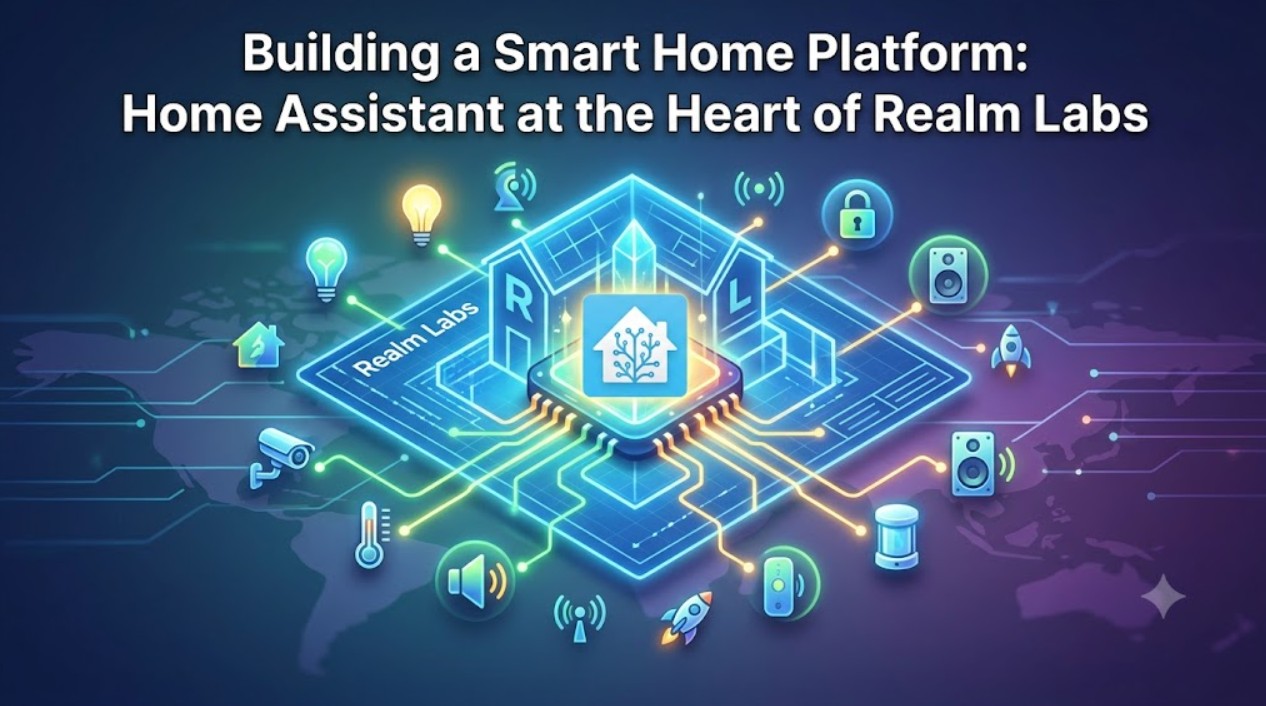
For Realm Labs, Home Assistant has become the central platform connecting different devices and automation projects together.
Why Home Assistant?
Many smart home ecosystems rely heavily on manufacturer platforms and cloud services.
Home Assistant takes a different approach by focusing on:
- Local control
- Privacy
- Flexibility
- Customisation
- Integrations with many different devices
Instead of having multiple disconnected apps, Home Assistant provides a single place to manage the home.
The Foundation
Home Assistant runs as part of the wider home lab environment.
The supporting infrastructure includes:
- Raspberry Pi systems
- Docker services
- Network connectivity
- MQTT messaging
- Node-RED automation
This allows smart home projects to become part of the same ecosystem as the rest of the lab.
Dashboards and Control
One of the most powerful features of Home Assistant is the ability to create custom dashboards.
Rather than simply controlling devices, dashboards can display:
- Device status
- Energy information
- Environmental data
- Network information
- System monitoring
The dashboard becomes a control centre for the home.
Automation with Node-RED
While Home Assistant provides powerful built-in automation, Node-RED adds another layer of flexibility.
Node-RED allows visual automation flows to be created for more advanced logic.
Examples include:
- Scheduled events
- Conditional actions
- Device interactions
- Custom project control
This approach makes complex automations easier to design and understand.
MQTT Communication
MQTT provides a lightweight communication system between devices and services.
It allows different systems to exchange messages without needing direct connections.
This is particularly useful for custom projects involving:
- Raspberry Pi devices
- Sensors
- Displays
- Custom electronics
- Automation controllers
Custom Projects
One of the most enjoyable parts of Home Assistant is creating completely custom solutions.
Projects can combine:
- Hardware
- Software
- Automation
- APIs
- Sensors
Examples include custom displays, interactive models and personalised control systems.
The Model TARDIS project is a great example of combining creativity with automation.
Lessons Learned
Smart home projects often look simple from the outside, but behind the scenes they involve many different technologies:
- Network design
- Device compatibility
- Automation logic
- Security considerations
- Reliable communication
The biggest lesson is that good infrastructure makes everything easier.
Future Plans
The smart home platform will continue to expand with:
- More automation
- Better energy monitoring
- Additional sensors
- Voice control
- AI integration
Conclusion
Home Assistant has become one of the most interesting parts of Realm Labs because it combines traditional IT skills with creativity.
It is where servers, networks, software and hardware all come together to create something practical.